


April 3, 2026
by Dwaign Tyndal
I can’t stop thinking about the Minab school in southern Iran, where a missile attack killed more than 100 schoolchildren on February 28th.
To me, it strongly echoes the Birmingham, Alabama church bombing in 1963, when white supremacists killed four Black girls. And it reminds me that this week marks 58 years since the assassination of Rev. Dr. Martin Luther King, Jr.
Today, I want to remember King’s shift, in his last few years, toward a broader understanding of justice and oppression — in particular, his conclusion that militarism is the third great evil we must oppose, alongside racism and poverty.
Across the globe today, our leaders are choosing militarism.
I can’t help but see Dr. King’s words as relevant. In his famous 1967 speech at New York City’s Riverside Church, amid the Vietnam War, King warned,
“We must rapidly begin the shift from a thing-oriented society to a person-oriented society. When machines and computers, profit motives and property rights, are considered more important than people, the giant triplets of racism, extreme materialism, and militarism are incapable of being conquered.” ... “True compassion is more than flinging a coin to a beggar. It comes to see that an edifice which produces beggars needs restructuring.”
Dr. Martin Luther King, Jr - "Beyond Vietnam: A Time to Break Silence", speech delivered at Riverside Church, April 4, 1967
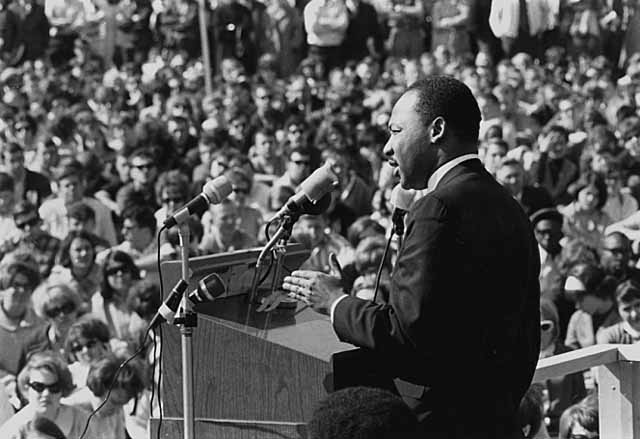
Photo: King speaks at an anti-Vietnam War rally in St. Paul, Minnesota, on April 27, 1967.
Attribution: Minnesota Historical Society, CC BY-SA 2.0 via Wikimedia Commons
Militarism is a hammer that makes everything look like a nail. It’s the mentality of “bomb first, ask questions later.” Poverty, racism, and militarism work in tandem to create an “other” who is less than fully human.
Military misadventures also have a real cost that stunts our efforts for justice, for civil rights, for equity and well-being for our people. It takes money we could spend on public services (like roads, transit, and safety), social support (food stamps, social housing), healthcare, and so much more. Spending two trillion on the military’s F-35 jet program was a choice to take that money away from us.
Second, militarism locks us into the logic of more dehumanization. When the public is forced to accept mass killings abroad, we risk becoming numb to police violence, poverty, and inequity at home.
And crucially, the US military machine is the largest institutional emitter of greenhouse gas pollution — a direct contributor to increased flooding, wildfires, droughts, and extreme heat events like we experienced last summer in Boston.
Our answer? We denounce militarism. And we must explicitly connect it to the fight against poverty and racism. Dr. King’s answer was “a true revolution of values.” We can’t know what he would make of today. But we can take his warnings seriously as we decide how we act.
I see King’s words come alive today:
Our government is continuing overpolicing and mass incarceration, and cracking down on Black and Brown people.
Corporate leaders are building data centers across our country at an unthinkable scale, polluting Black and Brown neighborhoods and spiking energy costs for everyone.
Media and tech companies are offering impunity to racists and platforming hateful discourse at the highest levels.
Our elected leaders are starting wars of choice with hardly an attempt at justification, while thousands of lives are lost.
At the heart of racism, poverty, and war is the logic of dehumanization: the idea that some people’s lives, rights, and joy just don’t matter — that they don’t count as fully human. King knew an anti-war speech would be polarizing, but he asked himself, how could he preach nonviolence as a movement strategy, without also speaking out against the “the greatest purveyor of violence in the world today, [our] own government”?
Today, it’s up to us. When we see dehumanization all around us — we’ve got to reclaim our humanity, and fight like hell to build justice and peace.
My organization, ACE, works closely with Black and Brown youth in Roxbury through our REEP program (Roxbury Environmental Empowerment Project). We reject dehumanization by helping our youth to find their voice, their power. Reasserting that they matter.
The rest of us should take that lesson to heart, too: we have power, even when we’ve been taught that we don’t.
Let’s start reclaiming our power and standing against militarism. Rejecting the call to dehumanize. Let’s work together to lift up everyone’s humanity, build collective power for justice, and blaze a path toward a better life for all.
